King’s College School, Wimbledon
Introduction
King’s College School, Wimbledon, commonly known as KCS Wimbledon or simply King’s, is one of the historic independent schools in England. Located beside Wimbledon Common in southwest London, the school has a history stretching back to the early nineteenth century. It was founded by royal charter in 1829 and originally operated as the junior department of King’s College London. After spending much of its early history in central London, the school moved to Wimbledon in 1897, where it developed into the large independent day school that exists today.
The history of King’s College School is closely connected with the development of modern education in Britain. From its earliest years, the school combined traditional academic subjects with mathematics, modern languages, science, drawing and other areas of study. Its curriculum developed alongside changes in British society, helping the institution maintain a reputation for academic breadth and intellectual ambition.
Today, King’s College School provides education across junior and senior years, with boys admitted through the main school years and girls joining the Sixth Form. Government information currently lists the school as a selective independent day school at Southside, Wimbledon Common, London, with an age range of 7 to 19 and a sixth form.
The school is also an International Baccalaureate World School. The International Baccalaureate records King’s College School, Wimbledon as having been authorised for the IB Diploma Programme since 31 October 2000.
This article explores the complete story of King’s College School, Wimbledon, including its foundation, move to Wimbledon, educational development, academic programmes, campus, traditions, extracurricular activities, admissions and continuing influence.
1. The Foundation of King’s College School
The origins of King’s College School go back to 1829, when King’s College London was established under a royal charter granted during the reign of King George IV.
The school was created as a junior department associated with the new college. Its original purpose was to provide education for boys while also forming a connection with the wider educational mission of King’s College London.
The school officially opened its doors to pupils in 1831. Historical records from King’s College London describe the school as a day school for boys, originally located in the basement of the college’s Strand building.
The original school was considerably smaller than the modern institution. Early records indicate that around 85 pupils were associated with the school at its beginning. Many of these boys lived in central London and could walk to the school.
During the nineteenth century, however, London’s population expanded rapidly and the school grew with it.
Within only a few years, pupil numbers increased dramatically. Historical records indicate that the school had around 500 pupils by the mid-1830s, demonstrating the demand for the education it provided.
This rapid growth eventually created pressure on the original premises and contributed to the decision to find a larger site.
2. Early Educational Philosophy
King’s College School developed during an important period in British educational history.
The nineteenth century saw growing interest in education beyond the classical curriculum traditionally associated with elite schools. Mathematics, science, modern languages, geography and practical subjects gradually became more important.
King’s College School reflected some of these changes.
Its early curriculum included classical subjects, mathematics, natural philosophy and modern languages. Drawing was also taught, giving pupils an opportunity to develop artistic and technical skills.
This broad curriculum became one of the important characteristics of the school.
The school was not simply concerned with examination preparation. Its educational environment reflected a wider Victorian interest in intellectual development, scientific discovery and cultural education.
One particularly notable development was the introduction of science teaching.
The school appointed its first science master in 1855, at a time when science was not yet a standard part of the curriculum at many schools. This is an important part of King’s College School’s educational history because it demonstrates an early willingness to incorporate scientific education into school life.
3. Important Early Teachers
The early history of King’s College School includes several notable teachers and cultural figures.
Among them was Gabriele Rossetti, an Italian scholar and poet who taught Italian at the school. His son, Dante Gabriel Rossetti, later became an important figure in British art and poetry and was himself a pupil at King’s College School.
Another important figure connected with the school was John Sell Cotman, the English watercolourist and artist.
Cotman’s involvement illustrates the breadth of the early curriculum. Art and drawing were not treated simply as recreational subjects; they were part of the school’s broader educational programme.
The school’s early teachers therefore represented different areas of intellectual and cultural life, including languages, science and the arts.
4. Growth During the Victorian Era
The Victorian period was an important stage in the development of King’s College School.
As London grew, the school continued to expand. By the 1840s, pupil numbers had reached approximately 500. The increase placed greater demands on buildings, staff and organisation.
The school also developed a growing reputation.
Its pupils came from families associated with the expanding middle classes, including professional, commercial and public-service backgrounds. Historical material from King’s College London describes the school’s mission as helping educate sons of the aspiring middle classes, including families connected with the army, commerce and manufacturing.
This reflected broader changes in nineteenth-century British society.
Education was increasingly viewed as an important route toward professional and intellectual advancement. Schools such as King’s College School became important institutions for families seeking a combination of academic education, discipline and social development.
5. The Move from London to Wimbledon
One of the most important events in the history of King’s College School was its move from central London to Wimbledon.
By the late nineteenth century, the original location in the Strand was no longer ideal for a rapidly expanding school.
In 1897, King’s College School moved to its present location at Wimbledon.
The move represented much more than a change of address.
Wimbledon offered a very different environment from central London. The new setting beside Wimbledon Common provided more open space and opportunities for sport and outdoor activities.
The school could now develop a larger campus suitable for a modern day school.
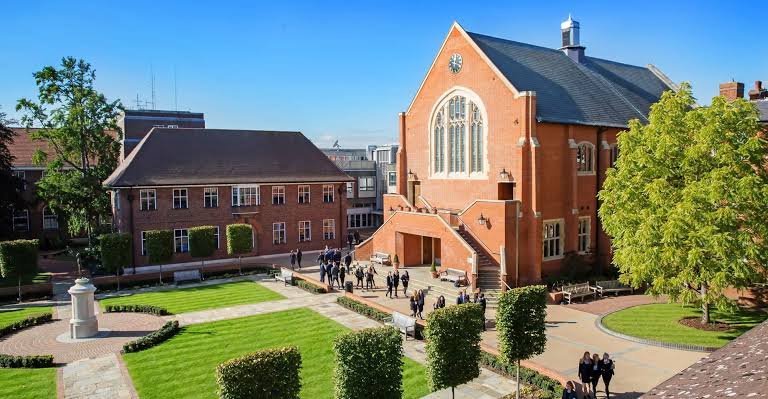
The opening of new buildings followed the move. Historical records identify the school’s new Wimbledon buildings as opening during the late nineteenth century, with the Great Hall becoming an important architectural feature of the campus.
6. The Wimbledon Campus
The Wimbledon location became central to the identity of King’s College School.
The school is situated at Southside, Wimbledon Common, London, SW19 4TT. Government records identify the institution as an independent school in the London Borough of Merton.
Its location provides an unusual combination of an urban London setting and access to one of the capital’s best-known open spaces.
Wimbledon Common has long influenced the character of the area.
For a school, the setting offers opportunities for outdoor education, physical activity and sport while remaining relatively close to central London.
Over time, the campus has been developed to support the needs of a modern school while retaining important elements of its historical character.
The Great Hall is particularly significant in the school’s architectural story. It was designed by Sir Banister Fletcher, and the new school buildings were opened in the late nineteenth century.
7. Becoming an Independent School
Although King’s College School began as part of King’s College London, it eventually developed its own independent identity.
The separation from the college was completed in the early twentieth century.
Historical records from King’s College London state that King’s College School became independent from King’s College London in 1911.
This was an important institutional transition.
The school was no longer simply the junior department of a university. It became a distinct educational organisation with its own governance, traditions and long-term educational mission.
Its connection with King’s College London remained an important part of its heritage, but the school developed independently during the twentieth century.
8. Development During the Twentieth Century
The twentieth century brought major changes to education, society and British life.
King’s College School adapted to these changes while retaining many of its traditional characteristics.
Academic education became increasingly structured around recognised examinations.
Science and mathematics became increasingly important, while languages, humanities and creative subjects remained part of the curriculum.
Sport also became a major part of school life.
The school’s location beside Wimbledon Common made outdoor activities particularly significant.
The twentieth century also saw the expansion of school societies, music, drama, debating, community service and other extracurricular opportunities.
The school therefore developed a model of education that extended beyond classroom learning.
9. King’s College School Today
King’s College School today is a selective independent day school.
Government information lists the school as an independent school with a current capacity of 1,555 and a reported enrolment of 1,498 pupils in the latest available record. The same government record lists Dr Anne Cotton as headteacher/principal.
The school’s structure includes junior and senior education and a sixth form.
Historically, the school has primarily educated boys, while girls have been admitted to the Sixth Form. Current international-school information similarly describes the institution as a boys’ school with coeducational sixth-form provision.
The school continues to operate as a day school rather than a boarding school.
10. Junior School Education
The junior stage provides the foundation for pupils’ later education.
At this age, students develop core skills in literacy, numeracy, scientific thinking and communication.
The school also places importance on activities outside traditional academic lessons.
Music, drama, sport, art and other activities can help younger pupils discover interests and develop confidence.
King’s College School’s wider educational approach is based on developing pupils as individuals rather than concentrating solely on examination performance.
This philosophy becomes increasingly important as pupils move into senior education.
11. Senior School Education
The senior school provides a broad academic curriculum.
Students study a range of subjects across sciences, mathematics, humanities, languages, creative disciplines and other areas.
The senior years are designed to prepare pupils for public examinations and higher education while also encouraging intellectual independence.
The school’s historic emphasis on academic breadth can be seen in the range of subjects available.
Science remains an important part of the curriculum, continuing a tradition that goes back to the appointment of the school’s first science master in 1855.
12. GCSE and IGCSE Education
At the secondary level, pupils normally work toward recognised qualifications such as GCSE and IGCSE examinations.
These qualifications provide an important foundation for Sixth Form study.
Students can select combinations of subjects according to their interests and future plans.
Academic preparation at this stage requires not only memorisation but also analysis, problem-solving, written communication and independent study.
For many students, GCSE results help determine their next educational pathway.
13. Sixth Form Education
The Sixth Form represents the final stage of school education before university or another post-18 pathway.
King’s College School provides a combination of A Level and International Baccalaureate options.
The International Baccalaureate confirms that King’s College School, Wimbledon has been an authorised IB World School since October 2000.
The IB Diploma is internationally recognised and provides students with a broad academic programme.
Its structure encourages students to study across different subject areas while also developing research, communication and critical-thinking skills.
A Levels provide a different structure, allowing students to specialise in selected subjects.
Offering both routes gives Sixth Form students different academic pathways.
14. The International Baccalaureate at King’s
The IB Diploma has become an important component of the school’s modern academic programme.
The International Baccalaureate’s official school listing confirms King’s College School as an authorised IB World School and identifies the IB Diploma Programme among its authorised programmes.
The programme includes subjects across areas such as mathematics, sciences, languages, history, geography, economics, philosophy and the arts.
The IB approach encourages students to connect knowledge between different disciplines.
This can be particularly valuable for students who want a broad educational experience before university.
15. Academic Culture
Academic ambition is one of the most visible characteristics of King’s College School.
The school encourages pupils to ask questions, investigate subjects and develop independent intellectual interests.
A strong academic culture does not necessarily mean that every student follows exactly the same route.
Different students have different strengths.
Some may have particular interests in mathematics or physics, while others may prefer history, languages, literature, music or art.
A broad curriculum allows these interests to develop.
16. Science and Innovation
Science has a particularly interesting place in King’s history.
The school appointed a science master in 1855, which was relatively early in the development of school science education.
Today, science education is much more developed.
Students can study disciplines such as biology, chemistry and physics, with opportunities to develop experimental and analytical skills.
Modern science education also encourages students to understand how scientific knowledge is developed.
Laboratory work, research projects and practical investigations can help students connect theoretical knowledge with real-world applications.
17. Mathematics
Mathematics has been part of the school’s curriculum since its earliest years.
The original curriculum included mathematics alongside classics, natural philosophy and modern languages.
Today, mathematics provides a foundation for many university disciplines.
Students interested in engineering, economics, computer science, medicine, physics and other fields often require strong mathematical preparation.
The school’s academic environment supports students who wish to explore mathematics beyond the standard curriculum.
18. Languages and Humanities
Modern and classical languages have also played an important role throughout King’s history.
The school taught modern languages during its early years, while figures such as Gabriele Rossetti contributed to language education.
Language education today can include modern European and other international languages as well as classical subjects.
Humanities subjects such as history, geography, literature and philosophy encourage students to examine society, culture and ideas.
These subjects help students develop research and communication skills that are valuable beyond school.
19. Arts and Creativity
Creativity forms another important part of school life.
The historical connection with artists such as John Sell Cotman and Dante Gabriel Rossetti illustrates the longstanding relationship between King’s and the arts.
Modern pupils can engage in areas such as visual arts, music and drama.
Creative activities provide opportunities for students to develop confidence, collaboration and presentation skills.
They also offer a different form of learning from traditional academic study.
20. Music at King’s College School
Music has an established place in the educational life of the school.
Students can participate in instrumental study, ensembles, orchestras, choirs and performances.
Music education can benefit students in several ways.
It requires concentration and discipline while also providing opportunities for creativity.
Performing in groups also teaches collaboration.
For many pupils, music becomes an important part of their school identity and community.
21. Drama and Performing Arts
Drama provides another opportunity for creative development.
School productions allow students to work together as actors, directors, musicians, designers and backstage teams.
Theatre also develops communication skills.
Students must learn how to speak clearly, work with others and respond to audiences.
For students who later enter professions outside the arts, these skills can remain useful.
22. Sport and Physical Education
Sport is an important part of life at King’s College School.
The school’s Wimbledon location provides a strong setting for outdoor activities.
Students can participate in a range of sports and physical activities.
School sport teaches more than physical fitness.
It can also develop teamwork, discipline, leadership and resilience.
Competitive sport gives students opportunities to represent their school and work toward shared goals.
At the same time, recreational physical activity can provide an important balance to academic work.
23. Life Beyond the Classroom
Education at King’s is not restricted to formal lessons.
Students have opportunities to participate in clubs, societies, competitions, performances and community activities.
These activities can help pupils discover interests that may not be visible through academic examinations.
For example, a student interested in technology may develop skills through a computing or robotics activity.
Another student may discover a passion for debate, music, theatre, sport or community service.
The variety of activities allows students to build individual identities within the larger school community.
24. Leadership Opportunities
As students become older, leadership opportunities become increasingly important.
Sixth Form students can take on responsibilities within school organisations, clubs, sports teams and other activities.
Leadership teaches students how to organise projects, communicate with others and take responsibility for decisions.
These experiences can also prepare students for university and employment.
25. Pastoral Education
Academic achievement is only one part of a successful school experience.
Pastoral care is concerned with students’ wellbeing, relationships, personal development and ability to manage the demands of school life.
A large independent school requires systems through which students can seek support from teachers and other adults.
Pastoral structures can also help students develop social responsibility and respect for others.
The school’s historic educational mission has increasingly been interpreted through a modern understanding of personal development and community.
26. Values and School Community
King’s College School has a Christian heritage and is associated with the Church of England.
Government records identify its religious character as Church of England and its religious ethos as Christian.
At the same time, the school has an educational community that includes students from different backgrounds.
The school’s educational environment therefore combines historical traditions with contemporary school life.
Its motto, “Sancte et Sapienter,” is commonly translated as “With holiness and wisdom.”
The phrase reflects the historical relationship between education, character and knowledge.
27. The School’s Connection with Wimbledon
The school’s identity is strongly linked with Wimbledon.
Moving to Wimbledon in 1897 transformed the physical environment of the institution.
The Common became part of the landscape around the school, while Wimbledon itself developed into a major southwest London community.
The school has consequently become an established part of the local educational landscape.
Its location also provides convenient access to London while maintaining a campus environment distinct from the centre of the city.
28. Relationship with Wimbledon Common Preparatory School
An important part of the wider King’s educational community is Wimbledon Common Preparatory School.
The preparatory school was founded in 1919 and later developed a close relationship with King’s College School.
In 2006, the Corporation of King’s College School acquired Wimbledon Common Preparatory School, consolidating the relationship between the two institutions.
This relationship has provided a pathway between preparatory and senior education.
The partnership has continued to develop over the years.
Recent information from Wimbledon Common Preparatory School describes the relationship as an important part of the schools’ shared history.
29. Admissions
Admission to King’s College School is selective.
Government information identifies the school’s admissions policy as selective.
The school offers different entry points depending on age and educational stage.
The junior school admissions process includes entry points for younger pupils.
The senior school has its own admissions arrangements, while Sixth Form applicants have additional academic requirements.
Because admission requirements and dates can change, families should consult the school’s official admissions information for the relevant year.
The school’s admissions pages currently provide information for prospective families and list junior school registration arrangements.
30. What Makes the School Historically Significant?
King’s College School has several features that make its history notable.
First, it was founded under royal charter in 1829.
Second, it developed from a junior department of King’s College London into an independent school.
Third, it moved from central London to Wimbledon in 1897.
Fourth, it introduced science education at an early stage.
Fifth, it has maintained a broad curriculum combining sciences, mathematics, languages, humanities and creative subjects.
Finally, it has continued adapting its educational structure, including the introduction of the International Baccalaureate.
These developments demonstrate how the school has changed while maintaining a connection with its historical identity.
31. Notable Alumni and Old Kings
Former pupils of King’s College School are traditionally known as Old Kings.
The school has educated individuals who have gone on to careers in politics, science, literature, business, the arts, academia and other fields.
The early school already had notable pupils.
Dante Gabriel Rossetti, one of the major figures associated with the Pre-Raphaelite movement, attended the school.
The school’s alumni tradition continues to be an important element of its identity.
Former pupils often maintain connections with the institution through alumni activities and events.
32. Architecture and Heritage
The physical campus is an important part of King’s history.
The late nineteenth-century buildings reflect the period when the school moved to Wimbledon.
Sir Banister Fletcher was involved in the design of the Great Hall, which became an important architectural feature of the new school.
Historic buildings provide a visible link between modern students and generations of pupils who studied at King’s before them.
At the same time, a modern school must continually update its facilities.
The challenge is to preserve heritage while providing spaces suitable for contemporary teaching.
33. The Importance of Tradition
Traditions can play an important role in schools with long histories.
At King’s, traditions connect current pupils with previous generations.
School houses, assemblies, competitions, performances, sporting events and ceremonial occasions create continuity.
Traditions also provide students with a sense of belonging.
However, traditions are not necessarily static.
A successful historic institution must adapt them to changing social expectations and educational needs.
King’s history demonstrates this process of continuity and change.
34. Academic Preparation for University
University preparation is an important part of Sixth Form education.
Students can follow A Levels or the IB Diploma, depending on their chosen academic route.
These qualifications provide preparation for higher education in Britain and internationally.
The IB’s international structure can be particularly relevant for students considering universities outside the United Kingdom.
A Levels, meanwhile, provide subject-specific depth that is familiar to British universities.
Students also receive guidance about university choices and future careers.
35. International Outlook
Although King’s College School has deep roots in British educational history, its modern outlook is international.
The International Baccalaureate programme provides one example.
Students also study international languages and subjects that encourage understanding of different cultures.
London itself contributes to the school’s international character.
As one of the world’s major cities, London provides access to cultural institutions, universities, museums, businesses and international communities.
Students therefore study in an environment where global perspectives are part of everyday life.
36. Technology and Modern Education
Modern schools must prepare students for a world shaped by technology.
Digital literacy is now relevant to almost every academic discipline.
Students need to understand how to research information, evaluate sources, communicate digitally and use technology responsibly.
Technology also supports classroom teaching.
However, education remains broader than digital skills.
Critical thinking, communication, creativity, teamwork and ethical decision-making remain essential.
King’s long educational history demonstrates the importance of adapting to new developments without abandoning foundational academic principles.
37. Community and Service
Community engagement can help students understand responsibilities beyond school.
Activities involving charity, volunteering and service encourage students to consider the needs of other people.
This is particularly relevant to the school’s wider emphasis on character and citizenship.
Community service can also help students develop practical skills.
Organising an event, raising funds or volunteering requires planning, communication and cooperation.
These experiences can therefore complement classroom education.
38. The Role of Teachers
Teachers are central to the educational experience at any school.
King’s history contains many examples of teachers who contributed to its academic and cultural development.
The early involvement of figures such as Gabriele Rossetti and John Sell Cotman demonstrates how specialist teachers helped shape the school’s curriculum.
Modern teachers continue this role by combining subject expertise with pastoral support.
A strong teacher can influence students not only through formal lessons but also through encouragement and intellectual curiosity.
39. Education Beyond Examination Results
Examination results are important for students and families, but they do not represent every aspect of education.
A school also contributes to personal development.
Students learn how to communicate, collaborate, solve problems and manage responsibilities.
They develop relationships with classmates and teachers.
They participate in activities that may eventually become lifelong interests.
King’s long history illustrates this broader concept of education.
40. King’s College School and the Future
The history of King’s College School shows continuous adaptation.
Founded in the nineteenth century, the school survived enormous changes in British society.
It moved from central London to Wimbledon.
It became independent from King’s College London.
Its curriculum expanded.
Science became increasingly important.
Modern qualifications were introduced.
The school developed international programmes.
These changes suggest that the institution’s future will continue to involve balancing tradition and innovation.
41. Why Wimbledon Is an Important Setting
Wimbledon is one of the most recognisable areas of southwest London.
It is internationally associated with tennis, but its identity extends far beyond the sport.
The area combines residential neighbourhoods, transport connections, green spaces and cultural institutions.
For King’s College School, the presence of Wimbledon Common is particularly significant.
Students have access to a setting that feels different from central London despite being part of Greater London.
This combination of accessibility and open space is one of the distinctive characteristics of the school.
42. A School with Nearly Two Centuries of History
From its foundation in 1829 to the present day, King’s College School has accumulated almost two centuries of institutional history.
Generations of pupils have passed through its classrooms.
The school has witnessed major changes including industrialisation, two world wars, technological transformation, changes in British society and the development of modern higher education.
Yet its fundamental educational purpose has remained recognisable: providing pupils with a demanding academic education while supporting broader personal development.
43. King’s College School in the Twenty-First Century
The twenty-first century has brought new expectations for schools.
Students increasingly require international awareness, digital skills, scientific literacy and the ability to adapt.
At the same time, traditional skills remain important.
Reading, writing, mathematics, communication and analytical thinking continue to form the foundation of education.
King’s College School combines these established academic principles with modern programmes such as the International Baccalaureate.
The IB’s official records confirm its long-standing authorisation at the school, dating from 2000.
44. Current Leadership
The school is currently led by Dr Anne Cotton.
Government school information identifies Dr Cotton as the headteacher/principal, while the International Baccalaureate also lists her as head of school.
Leadership at a historic school involves managing both continuity and change.
A head must oversee academic standards, staff, student welfare, facilities, admissions and the wider school community.
At King’s, this leadership takes place within a long institutional tradition.
45. King’s College School as an Educational Community
A school is more than its buildings and examination results.
It is a community made up of students, teachers, families, former pupils and staff.
King’s College School’s long history means that this community extends across generations.
Current students become part of an institution whose history began almost two hundred years ago.
This continuity can give students a strong sense of belonging.
46. Frequently Asked Questions
When was King’s College School, Wimbledon founded?
King’s College School was founded by royal charter in 1829 and opened to pupils in 1831 as the junior department of King’s College London.
Where is King’s College School located?
The school is located at Southside, Wimbledon Common, London, SW19 4TT.
When did King’s College School move to Wimbledon?
The school moved from its original Strand location to Wimbledon in 1897.
When did King’s College School become independent?
The school became independent from King’s College London in 1911.
Is King’s College School a boarding school?
No. King’s College School is a day school. Government information identifies it as having no boarding provision.
Is King’s College School coeducational?
The school’s main provision has traditionally been for boys, with girls admitted to the Sixth Form. International school information describes the school as boys’ day education with a coeducational Sixth Form.
Does King’s College School offer the IB?
Yes. King’s College School is an authorised International Baccalaureate World School and has offered the IB Diploma Programme since its authorisation in 2000.
Does the school offer A Levels?
Yes. King’s provides A Level study alongside the International Baccalaureate route in the Sixth Form.
Is admission to King’s College School selective?
Yes. UK government information identifies the school’s admissions policy as selective.
What is the school’s motto?
The school’s motto is “Sancte et Sapienter,” generally translated as “With holiness and wisdom.”
Who are Old Kings?
Old Kings is the traditional name used for former pupils of King’s College School.
Who was Dante Gabriel Rossetti?
Dante Gabriel Rossetti was a nineteenth-century artist and poet associated with the Pre-Raphaelite movement. He attended King’s College School as a pupil.
Does King’s College School have a long history of science education?
Yes. The school appointed its first science master in 1855, an early date compared with the development of science education in many schools.
Is King’s College School connected to King’s College London today?
The school originated as the junior department of King’s College London, but it became independent in 1911. Its historical connection remains an important part of its heritage.
Conclusion
King’s College School, Wimbledon is an institution whose history reflects the changing nature of British education.
Founded in 1829 and opened to pupils in 1831, the school began as the junior department of King’s College London. Its early curriculum combined classics, mathematics, natural philosophy, modern languages and drawing. The school expanded rapidly, and by the nineteenth century it had become a significant educational institution.
Its appointment of a science master in 1855 demonstrates an early willingness to embrace developments in education. The move from the Strand to Wimbledon in 1897 created the physical environment in which the modern school could develop.
The transition to independence from King’s College London in 1911 was another major stage in its history.
Today, King’s College School operates as a selective independent day school at Wimbledon Common. It provides junior, senior and Sixth Form education and combines traditional academic subjects with modern educational programmes. Its International Baccalaureate programme, authorised since 2000, gives students an internationally recognised academic pathway.
The school also maintains a broad educational programme involving science, mathematics, languages, humanities, arts, music, drama, sport and extracurricular activities.
Perhaps the most important feature of King’s College School is the way its long history continues to influence its modern identity. The buildings, traditions, alumni, curriculum and location all connect present-day students with generations of pupils who studied at the school before them.
From its beginnings in nineteenth-century London to its modern campus beside Wimbledon Common, King’s College School has evolved considerably while maintaining a clear commitment to academic education and personal development.
For anyone researching historic British schools, independent education in London, International Baccalaureate schools, or the history of King’s College School Wimbledon, the institution provides an excellent example of how a school can preserve its heritage while continuing to adapt to the educational needs of new generations.
SEO Keywords
King’s College School Wimbledon, King’s College School, KCS Wimbledon, King’s Wimbledon, King’s College School history, King’s College School admissions, King’s College School fees, King’s College School London, King’s College School Wimbledon history, King’s College School IB, King’s College School A Levels, King’s College School sixth form, King’s College School junior school, Wimbledon independent schools, best schools in Wimbledon, schools in southwest London, King’s College School campus, King’s College School alumni, King’s College School education, King’s College School curriculum.
Suggested SEO Title
King’s College School, Wimbledon: Complete History, Education, Admissions and Legacy
Suggested Meta Description
Explore the complete history of King’s College School, Wimbledon, from its 1829 foundation and 1897 move to Wimbledon to its modern academic programmes, IB, campus, admissions and traditions.