Horace Mann School: A Complete History, Academic Excellence, Campus Life and Educational Legacy
Introduction
Horace Mann School is one of the best-known independent college-preparatory day schools in New York City. Founded in 1887, the school has developed from an experimental educational unit connected with Teachers College, Columbia University, into a large coeducational independent school serving students from Nursery through Grade 12. Today, Horace Mann School operates across campuses in Manhattan and the Bronx and also maintains the John Dorr Nature Laboratory, an outdoor education center in Washington, Connecticut.
The history of Horace Mann School is closely connected with the development of modern education in the United States. From its earliest years, the institution was interested in education as more than the memorization of facts. Its founders and educators emphasized experimentation, intellectual development, character, responsibility, and preparation for meaningful participation in society.
Over more than a century, Horace Mann has changed considerably. It has moved locations, developed separate boys’ and girls’ educational programs, become independent from Teachers College, returned to coeducation, expanded its grade levels, and created a multi-campus educational environment. Despite those changes, the school states that its central purpose remains the development of students who can lead “great and giving lives.”
This article explores the history of Horace Mann School, its founder and namesake, educational philosophy, academic program, campus development, student life, arts, athletics, community engagement, admissions, and continuing legacy.
The Founding of Horace Mann School
Horace Mann School was established in 1887 by Nicholas Murray Butler as a coeducational experimental and developmental unit of Teachers College. At the time, educational institutions were increasingly interested in finding better ways to prepare teachers and improve classroom instruction.
The original school was located at No. 9 University Place in New York City. Its relationship with Teachers College gave it a distinctive purpose. Rather than functioning simply as a conventional school for children, it also served as a place where educational ideas could be explored and developed.
The school was named after Horace Mann, an influential nineteenth-century American education reformer. Mann had served as the first Secretary of the Massachusetts Board of Education and later served in the United States House of Representatives and as president of Antioch College. The founders selected his name because of his association with public education and educational reform.
The connection between Horace Mann’s philosophy and the new school was significant. Mann argued that education should be broadly available and should contribute to the development of a free society. His educational ideas emphasized the importance of schools in developing informed and responsible citizens.
The early Horace Mann School therefore emerged at the intersection of educational experimentation and academic preparation.
Early Years and Teachers College Connection
During its early decades, Horace Mann School maintained a close relationship with Teachers College. This relationship influenced the school’s educational culture and helped establish its reputation as an institution interested in educational innovation.
In 1891, Nicholas Murray Butler left the presidency of Teachers College, and Dr. William Hervey became president. A few years later, in 1894, Horace Mann School and Teachers College moved into a single building on 120th Street.
Virgil Prettyman became principal of Horace Mann School in 1894. His leadership became an important part of the institution’s early development.
By the beginning of the twentieth century, Horace Mann was becoming increasingly recognized as a school in its own right. In 1901, the school moved into its own building at 120th Street and Broadway in Morningside Heights.
The school’s development during this period reflected an important transition. Originally conceived as an experimental and developmental school connected to teacher education, Horace Mann was gradually becoming a prominent educational institution with an identity of its own.
Teachers College eventually established the Lincoln School as a separate coeducational institution for experimental teaching. As a result, Horace Mann increasingly operated with greater independence from the experimental mission of Teachers College.
The Move Toward Riverdale
One of the most important developments in Horace Mann’s history was its connection with Riverdale in the Bronx.
In 1909, Teachers College purchased property on 246th Street in the Fieldston section of the Bronx. Alumni Field was established there as an athletic facility.
A few years later, the school expanded its presence in the area. Horace Mann School for Boys opened on 246th Street in 1914, while the girls’ high school remained in the Teachers College area.
The development of the Riverdale campus eventually became central to the identity of Horace Mann School.
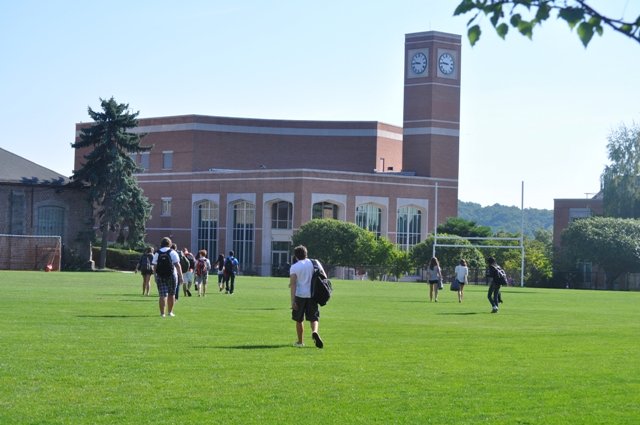
Riverdale provided a setting different from the dense urban environment of central Manhattan. The school’s Bronx location allowed it to develop a substantial campus with classrooms, athletic facilities, laboratories, arts spaces, and outdoor areas.
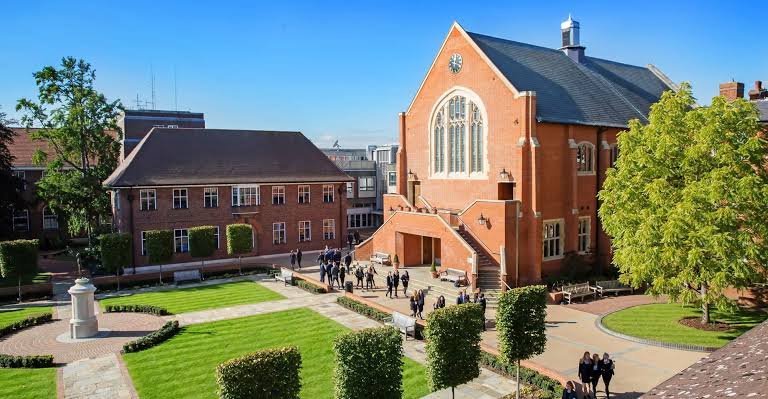
The present-day main campus remains in the Riverdale neighborhood of the Bronx.
Horace Mann School for Boys and Girls
For part of its history, Horace Mann’s educational structure was divided between boys and girls.
Horace Mann School for Boys developed its campus in Riverdale, while Horace Mann High School for Girls remained associated with Teachers College.
In 1920, Charles Carpenter Tillinghast was appointed headmaster. In 1924, the Prettyman Gymnasium and Pool opened, demonstrating the school’s growing interest in physical education and athletics.
The history of the girls’ school also evolved during the twentieth century. In 1940, Horace Mann High School for Girls merged with the Lincoln School. Horace Mann-Lincoln School subsequently closed in 1946.
The following year marked a major turning point for Horace Mann.
Independence from Teachers College
In 1947, Horace Mann School for Boys obtained complete financial and administrative independence from Teachers College.
A new Board of Trustees received a provisional charter, and the institution returned to the name Horace Mann School.
This transition was extremely important because it established Horace Mann as an independent school rather than a division operating under the administration of Teachers College.
Independence allowed the school to develop its own governance, educational policies, financial structure, and long-term institutional priorities.
Although the formal connection with Teachers College ended, the intellectual heritage of educational experimentation remained an important part of the school’s identity.
The Return to Coeducation
Horace Mann’s modern identity as a coeducational school developed gradually.
The school reestablished coeducation through a series of mergers and admissions changes. In 1968, Horace Mann merged with the New York School for Nursery Years. In 1972, it merged with the Barnard School. Girls began entering the high school in 1975.
These developments eventually produced the modern structure of Horace Mann School.
Today, the institution serves students from Nursery through Grade 12 and describes itself as a coeducational, college-preparatory independent day school.
The return to coeducation was not simply an administrative change. It helped shape the school’s contemporary community by bringing students of different ages, backgrounds, interests, and experiences into one educational system.
Horace Mann School Today
More than a century after its founding, Horace Mann School has become a large independent day school.
The school currently describes itself as serving more than 1,800 students across Nursery through Grade 12. It operates campuses in Manhattan and the Bronx, along with a 320-acre outdoor education center in Washington, Connecticut.
The school’s main academic campus is located in Riverdale in the Bronx. The Nursery Division is located in Manhattan, while the John Dorr Nature Laboratory provides an outdoor educational environment in Connecticut.
This multi-campus structure allows Horace Mann to provide different types of learning environments for students at different stages of their education.
Educational Philosophy
Education at Horace Mann is built around a combination of intellectual development, personal responsibility, community participation, and academic challenge.
The school’s mission states that Horace Mann prepares a diverse community of students to lead great and giving lives. It emphasizes a safe and caring environment where mutual respect, mature behavior, and the life of the mind can thrive.
This philosophy reflects the school’s historical connection to educational reform.
Horace Mann does not describe education simply as preparation for examinations. Instead, the school emphasizes the broader development of students as thinkers and members of society.
The school identifies several important values, including:
- The life of the mind
- Mature behavior
- Mutual respect
- A secure and healthful environment
- A balance between individual achievement and a caring community
These principles influence both classroom learning and extracurricular activities.
The Life of the Mind
One of the most recognizable concepts associated with Horace Mann School is “the life of the mind.”
This idea refers to intellectual curiosity, independent thinking, thoughtful discussion, and the pursuit of knowledge.
Students are encouraged to ask questions rather than simply memorize answers.
A strong academic culture requires students to engage with ideas, examine evidence, understand different perspectives, and develop their own reasoned conclusions.
This approach is particularly relevant in subjects such as history, literature, science, mathematics, languages, and the arts.
The school describes its curriculum as a liberal arts education that has continued to evolve since its founding. Its admissions materials emphasize academic challenge, creative problem solving, collaboration, service learning, identity, and exploration.
Academic Program
Horace Mann’s academic program covers the educational journey from the early years through high school.
The school is organized into several divisions that correspond to different stages of development.
These include:
- Nursery Division
- Lower Division
- Middle Division
- Upper Division
Each division has its own educational priorities while remaining connected to the broader philosophy of the institution.
The Lower Division focuses on establishing strong foundations in academic disciplines. The school explains that students receive enriched learning opportunities and interdisciplinary experiences.
As students progress through the Middle and Upper Divisions, their coursework becomes increasingly specialized and academically demanding.
Lower Division Education
The Lower Division provides education for younger students in the Riverdale area.
The school’s current admissions information describes the Lower Division as welcoming approximately 460 children from Kindergarten through Grade 5. The campus includes classrooms, a library, gymnasium, cafeteria, arts and technology center, music facilities, language classrooms, literacy and mathematics spaces, science facilities, and administrative offices.
Outdoor areas also support learning and recreation.
The curriculum is designed to establish strong foundations while recognizing that young students learn in different ways.
Fourth- and fifth-grade students experience a departmental schedule with several subject-area teachers. According to the school, this arrangement helps students develop organizational and executive-functioning skills before moving into the Middle Division.
Middle Division
The Middle Division represents an important stage between elementary education and high school.
Students are introduced to greater academic independence and are encouraged to take increasing responsibility for their learning.
At this stage, students can explore a broader range of subjects and develop skills that will become increasingly important in Upper Division coursework.
The transition from one division to another is designed to help students grow academically, socially, and personally.
Upper Division
The Upper Division covers the high school years.
At this stage, students encounter advanced academic subjects, independent projects, extracurricular opportunities, athletics, arts programs, and college counseling.
The academic experience is designed to encourage students to pursue areas of particular interest while maintaining a broad liberal arts foundation.
The school’s educational philosophy places importance on both depth and breadth. Students can study traditional disciplines while also exploring specialized subjects, interdisciplinary questions, creative work, research, and community engagement.
Liberal Arts Tradition
The liberal arts tradition is an important part of Horace Mann’s academic identity.
A liberal arts education encourages students to study multiple fields rather than specializing too early.
Students can develop skills in:
- Literature
- History
- Mathematics
- Science
- Languages
- Social sciences
- Visual arts
- Performing arts
- Technology
- Physical education
The purpose of such breadth is to help students understand relationships between different forms of knowledge.
For example, a student studying environmental science might also explore environmental policy, literature, history, or economics.
Similarly, a student interested in technology can benefit from mathematics, writing, ethics, design, and communication.
Science and Innovation
Science education has an important role in a modern college-preparatory curriculum.
Horace Mann provides opportunities for students to study scientific disciplines through classroom instruction, laboratory experiences, research, and interdisciplinary projects.
The school’s approach encourages students to investigate questions rather than simply memorize scientific information.
Laboratory learning can help students understand how scientific knowledge is developed through observation, experimentation, analysis, and revision.
The same habits of inquiry are useful beyond science.
Mathematics Education
Mathematics at Horace Mann provides students with opportunities to develop logical reasoning and quantitative skills.
Beginning with foundational concepts in the Lower Division, mathematics becomes progressively more sophisticated as students move through the school.
Students can encounter areas such as algebra, geometry, functions, statistics, calculus, and other advanced mathematical topics depending on their academic pathway.
Mathematics is not only useful for students who intend to pursue technical careers. Quantitative reasoning is also important in economics, social sciences, environmental studies, business, and everyday decision-making.
English and Literature
English and literature programs encourage students to read carefully, interpret texts, communicate clearly, and write effectively.
Literary study can introduce students to different historical periods, cultures, genres, and perspectives.
Writing assignments encourage students to organize arguments, analyze evidence, develop ideas, and communicate with precision.
These skills are essential for university-level study and professional life.
The study of literature also encourages students to think about human experiences, ethical questions, identity, society, and culture.
History and Social Sciences
History and social sciences provide another major component of the Horace Mann curriculum.
Students can study historical events, political systems, societies, cultures, economics, and social change.
The school’s own history program has emphasized the importance of thinking historically—examining causes, consequences, connections, evidence, and different perspectives. A 2012 school publication describing the 125th anniversary activities noted that students were encouraged to explore historical questions and make connections across cultures and eras.
This approach helps students understand that history is not simply a list of dates.
Languages and Global Learning
Language education is another part of a broad liberal arts curriculum.
Learning another language can provide students with opportunities to explore cultures and develop communication skills.
Language study can also strengthen understanding of how culture, history, literature, and identity are connected.
Horace Mann has historically provided opportunities for students to participate in study-abroad experiences, giving students additional opportunities to engage with international environments.
Arts at Horace Mann
Education at Horace Mann extends beyond traditional academic subjects.
The school provides opportunities in visual arts, music, theater, and other creative disciplines.
Artistic education can help students develop imagination, discipline, communication, and confidence.
Music students may participate in performance groups, while theater students can explore acting, directing, stagecraft, and production.
Visual arts students can work with different materials, techniques, and concepts.
Creative education is particularly valuable because it allows students to communicate ideas in forms that are different from traditional academic writing.
Athletics and Physical Education
Athletics has been part of Horace Mann’s history for many decades.
The opening of the Prettyman Gymnasium and Pool in 1924 reflected the school’s long-standing interest in physical education.
Today, athletics remains an important part of student life.
School sports can teach students about teamwork, discipline, preparation, leadership, communication, and resilience.
Athletic participation also provides opportunities for students to build relationships with classmates and represent their school in competition.
The school balances athletic participation with its broader academic mission.
Campus and Facilities
Horace Mann’s campuses have developed significantly over the institution’s long history.
The principal Riverdale campus includes facilities designed for academic, artistic, athletic, and community activities.
The Lower Division campus includes classrooms, libraries, science facilities, music spaces, arts and technology areas, and athletic facilities.
The Nursery Division is located in a historic Manhattan building that was originally the carriage house of the Andrew Carnegie estate. The structure was later expanded and adapted for educational use. The Nursery campus includes classrooms, a library, studio space, outdoor play areas, and a rooftop playground.
The combination of historic buildings and modern educational spaces reflects the school’s ability to preserve its heritage while adapting to contemporary educational needs.
John Dorr Nature Laboratory
One of the distinctive components of Horace Mann’s educational environment is the John Dorr Nature Laboratory in Washington, Connecticut.
The outdoor education center gives students an opportunity to learn outside the traditional classroom.
Outdoor education can connect academic concepts with direct experiences in nature.
Students can explore ecology, environmental science, geography, observation, teamwork, and stewardship through activities that take place in natural surroundings.
The school’s current materials describe the outdoor center as a 320-acre facility.
This facility represents an extension of Horace Mann’s broader educational philosophy: learning can happen through direct experience as well as classroom study.
Community and Citizenship
Horace Mann places significant emphasis on community responsibility.
Its mission connects education with the idea of leading “great and giving lives.” This means that individual achievement is considered alongside responsibility toward others.
Students are encouraged to participate in service and community activities.
The school has also developed relationships with organizations and schools in the Bronx and New York City.
For example, Horace Mann has described its collaboration with the Bronx Center for Science and Mathematics, including connections among teachers and administrators and sharing educational resources.
The school has also supported programs that provide educational opportunities for students outside its own enrollment community.
Diversity and Inclusion
Horace Mann describes itself as a diverse educational community.
The school’s mission emphasizes respect, care, and the contributions of individual students.
A diverse school environment can provide opportunities for students to learn from classmates with different backgrounds and experiences.
Diversity is relevant not only to student demographics but also to classroom discussion, literature, history, cultural studies, arts, and community engagement.
The school states that it values diversity among both students and adults working in the institution.
Student Life
Student life at Horace Mann extends beyond the classroom.
Students can participate in:
- Academic clubs
- Athletics
- Music
- Theater
- Visual arts
- Community service
- Student organizations
- Leadership activities
- Outdoor education
- Special academic programs
The large size of the school provides students with many possible activities and communities.
A student interested in science can participate in scientific activities while also playing a sport or performing in an ensemble.
This variety allows students to develop different sides of their personality.
The Honor Code
Honor and responsibility are important themes in the Horace Mann tradition.
The school’s culture emphasizes mature behavior and mutual respect.
An honor-based environment encourages students to take responsibility for their work and conduct.
Academic integrity is especially important in a demanding educational environment.
Students need to understand that learning is most valuable when the work represents their own effort and thinking.
The school’s emphasis on honor also connects with its broader belief that character is an important part of education.
College Preparation
As a college-preparatory independent school, Horace Mann places considerable emphasis on preparing students for university study.
College preparation begins long before students submit applications.
Strong preparation includes developing:
- Writing skills
- Research skills
- Quantitative reasoning
- Reading comprehension
- Independent study habits
- Time management
- Communication skills
- Intellectual curiosity
- Personal responsibility
Upper Division students have access to college counseling and guidance as they consider universities and future academic interests.
The goal of college preparation is not simply admission to a university but preparation for success once students arrive there.
Admissions to Horace Mann School
Horace Mann School is known for having a selective admissions process.
The school considers applicants within the context of its educational philosophy and available places.
Admissions information emphasizes students who appreciate intellectual challenge and are interested in academic exploration, creative problem solving, collaboration, service learning, identity, and extracurricular opportunities.
For younger students, admissions processes differ from those for older applicants.
The school provides specific information for families applying to different divisions.
Once students are enrolled, the school states that they do not need to reapply from one grade to the next.
The Importance of Teachers
Teachers are central to the Horace Mann educational experience.
A rigorous curriculum requires educators who can challenge students while also supporting their development.
The school describes its faculty as an important part of its educational community and seeks teachers who can make their subjects accessible and exciting to students.
The relationship between teachers and students is especially important in an independent school.
Small-group discussions, projects, laboratory work, seminars, writing conferences, and extracurricular activities can allow students and teachers to interact beyond traditional lectures.
A Balance Between Achievement and Community
One of Horace Mann’s stated values is the balance between individual achievement and a caring community.
This balance is important because highly academic environments can place significant demands on students.
The school seeks to combine ambitious academic expectations with respect and care.
Individual achievement is recognized, but the school’s philosophy also emphasizes contribution to the community.
This can include helping classmates, participating in service projects, supporting athletic teams, performing in school productions, or taking leadership roles.
Horace Mann’s Educational Legacy
The legacy of Horace Mann School extends beyond its buildings.
Its history represents more than 130 years of educational development.
The institution began as an experimental school connected with Teachers College and eventually became an independent coeducational day school.
Throughout its history, the school has adapted to changing educational conditions.
Its transformation from a nineteenth-century experimental school into a modern independent institution illustrates the changing nature of American education.
At the same time, several themes have remained consistent:
- Academic inquiry
- Educational innovation
- Intellectual development
- Character
- Community
- Responsibility
- Service
Famous Alumni and Broader Influence
Over its long history, Horace Mann has educated many graduates who have gone on to careers in fields such as literature, journalism, science, business, law, entertainment, politics, medicine, technology, and the arts.
The significance of an alumni network is not simply the number of famous graduates.
A strong alumni community can provide current students with examples of different career paths and opportunities to remain connected to their school after graduation.
Horace Mann’s long history has produced generations of alumni who continue to contribute to communities around the world.
Horace Mann and New York City
The location of Horace Mann School gives it a distinctive relationship with New York City.
The school is situated in Riverdale, a residential area of the Bronx, while its Nursery Division is located in Manhattan.
New York City provides an enormous educational resource.
Museums, universities, libraries, theaters, cultural organizations, businesses, scientific institutions, and public spaces can all become extensions of classroom learning.
For students, living and learning near one of the world’s major cultural centers can provide opportunities to connect academic subjects with real-world experiences.
The Bronx and Community Connections
Horace Mann’s location in the Bronx also shapes its community identity.
The school has described programs and partnerships involving other schools and organizations in the borough.
One example is its collaboration with the Bronx Center for Science and Mathematics. The relationship included communication among teachers and administrators as well as sharing resources.
Community engagement can help students understand that education does not exist separately from society.
Schools operate within communities, and students can contribute to those communities through service and collaboration.
A School Built on Change
Perhaps one of the most interesting features of Horace Mann’s history is how often the institution has changed.
It began as a coeducational experimental school.
It later developed separate boys’ and girls’ educational structures.
The boys’ school moved to Riverdale.
The institution became financially and administratively independent from Teachers College.
Later, coeducation was restored.
The school eventually developed a modern structure extending from Nursery through Grade 12.
These changes show that educational institutions can preserve their identity while adapting to new circumstances.
Technology and Modern Education
Modern students require skills that were not imagined when Horace Mann was founded in 1887.
Technology now affects nearly every academic discipline.
Students use digital tools for research, communication, writing, design, data analysis, collaboration, and creative work.
However, technology is most useful when it supports deeper thinking rather than replacing it.
The central educational principles of curiosity, reasoning, communication, and responsibility remain relevant even as tools change.
Horace Mann’s historical willingness to evolve provides a foundation for responding to new educational challenges.
Preparing Students for the Future
A modern education must prepare students for a world that can change quickly.
Students may enter careers that are transformed by artificial intelligence, automation, biotechnology, climate change, globalization, and other developments.
Because of this uncertainty, education needs to provide more than a fixed collection of facts.
Students need to know how to learn.
They need to evaluate information, communicate ideas, solve problems, work with others, and adapt to unfamiliar situations.
The liberal arts tradition at Horace Mann provides a framework for developing these skills.
Character and Responsibility
Academic excellence is only one part of the school’s educational philosophy.
Horace Mann also emphasizes mature behavior, mutual respect, and community responsibility.
These values encourage students to think about the consequences of their decisions.
Character education can appear in many forms:
- Classroom behavior
- Academic integrity
- Teamwork
- Leadership
- Community service
- Respectful disagreement
- Responsibility for school property
- Support for classmates
These everyday experiences can influence students long after graduation.
Learning Beyond the Classroom
One of the strengths of a comprehensive school is the ability to provide many learning environments.
Students can learn in:
- Classrooms
- Laboratories
- Libraries
- Art studios
- Music rooms
- Theaters
- Athletic fields
- Gymnasiums
- Outdoor environments
- Community organizations
The John Dorr Nature Laboratory is an especially clear example of learning outside a traditional school building.
Such experiences can make education more memorable because students encounter ideas through direct participation.
Why Horace Mann School Has Remained Important
Horace Mann School has remained significant because its identity combines tradition with adaptation.
Its history reaches back to the nineteenth century, but its educational program continues to evolve.
The school has maintained a commitment to intellectual life while expanding opportunities in technology, arts, athletics, outdoor education, and community engagement.
Its mission also places emphasis on using education for purposes beyond personal advancement.
Frequently Asked Questions About Horace Mann School
When was Horace Mann School founded?
Horace Mann School was founded in 1887 as a coeducational experimental and developmental unit of Teachers College, Columbia University.
Where is Horace Mann School located?
The school’s main campus is in the Riverdale neighborhood of the Bronx, New York. The Nursery Division is located in Manhattan, and the school also operates the John Dorr Nature Laboratory in Washington, Connecticut.
Is Horace Mann School coeducational?
Yes. Horace Mann is currently a coeducational school serving students from Nursery through Grade 12. The school returned to coeducation through mergers and the admission of girls to the high school beginning in 1975.
Is Horace Mann School a public school?
No. Horace Mann School is an independent day school.
What grades does Horace Mann School serve?
The school serves students from Nursery through Grade 12.
What is Horace Mann School known for?
Horace Mann is known for its long educational history, rigorous liberal arts curriculum, independent-school environment, academic programs, arts, athletics, community engagement, and connection to New York City.
Who was Horace Mann?
Horace Mann was an American education reformer who served as the first Secretary of the Massachusetts Board of Education, later represented Massachusetts in the U.S. House of Representatives, and served as president of Antioch College.
When did Horace Mann become independent?
Horace Mann School obtained complete financial and administrative independence from Teachers College in 1947.
Does Horace Mann have a campus outside New York?
Yes. The school operates the John Dorr Nature Laboratory in Washington, Connecticut, an outdoor education center that the school currently describes as covering 320 acres.
Does Horace Mann offer arts and athletics?
Yes. Arts, athletics, and extracurricular activities are important parts of student life at the school.
Is admission to Horace Mann competitive?
Horace Mann describes its admissions process as selective. Applicants are considered in relation to the school’s educational mission, community, and available spaces.
Conclusion
Horace Mann School has a history that spans more than a century and reflects many of the major developments in American education.
Founded in 1887 as an experimental and developmental school connected to Teachers College, Columbia University, it gradually developed an independent identity. Its history includes the creation of boys’ and girls’ programs, the move to Riverdale, independence from Teachers College, and the eventual restoration of coeducation.
Today, Horace Mann is a coeducational independent day school serving students from Nursery through Grade 12. Its campuses in Manhattan and the Bronx, together with the John Dorr Nature Laboratory in Connecticut, provide a wide range of educational environments.
The school’s educational philosophy combines academic challenge with character, respect, community, service, creativity, and intellectual curiosity.
Its emphasis on “the life of the mind” reflects a belief that education should encourage students to think deeply and independently. At the same time, the school’s mission emphasizes that individual achievement should exist alongside responsibility to others.
From its nineteenth-century origins to its modern multi-campus structure, Horace Mann School demonstrates how an educational institution can evolve while maintaining a recognizable set of values.
For students and families researching leading independent schools in New York City, Horace Mann’s long history, academic program, extracurricular opportunities, community focus, and educational philosophy make it an important institution to understand.
Most importantly, the story of Horace Mann School is not only a story about buildings, dates, and institutional changes. It is a story about the continuing purpose of education: helping young people develop knowledge, curiosity, character, responsibility, and the ability to contribute meaningfully to the world around them.
SEO Keywords
Horace Mann School, Horace Mann School history, Horace Mann School New York, Horace Mann School Bronx, Horace Mann School Riverdale, Horace Mann School admissions, Horace Mann School academics, Horace Mann School tuition, Horace Mann School campus, Horace Mann School history and legacy, independent schools in New York City, best private schools in New York, Horace Mann School education, Horace Mann School students, Horace Mann School alumni, Horace Mann School academic program, Horace Mann School athletics, Horace Mann School arts, Horace Mann School Connecticut campus, John Dorr Nature Laboratory.
Suggested SEO Title
Horace Mann School: Complete History, Academics, Campus Life and Legacy
Suggested Meta Description
Explore the complete history of Horace Mann School, including its 1887 founding, connection with Teachers College, Riverdale campus, academics, student life, arts, athletics, admissions and educational legacy.